


The final week of July 2026 was a dramatic, high-stakes rollercoaster on Wall Street as expected. After navigating sharp sector swings, a highly divided Federal Reserve meeting, and heavy macroeconomic data, a late-week short squeeze in technology enabled the broad market to claw back into positive territory for the week.
Many storms were anticipated last week in this publication, with each day bringing its own unique set of volatility drivers:
1. The Federal Reserve: A Hawkish Hold
The Federal Reserve took center stage on Wednesday, voting 9–3 to leave its benchmark interest rate unchanged in the 3.50% to 3.75% range. However, the decision was far more hawkish than anticipated. Three regional Fed presidents dissented, voting instead for an immediate 25-basis-point interest rate hike due to sticky inflation that has remained above target for five years. Fed Chairman Kevin Warsh emphasized a period of watchful thinking, driving up pressure for a potential rate hike in September.
2. Major Corporate Earnings: The AI Capex Battle
Earnings season entered its most critical phase, with investors heavily scrutinizing whether massive corporate infrastructure spending on artificial intelligence would damage near-term profitability.
MSFT: Acted as the tech sector’s savior. Shares soared 15.5% on Thursday, recording the largest single-day market-cap gain in U.S. history, after delivering robust Azure cloud results that proved its massive AI capital investments are successfully materializing into growth. The bounce was consistent with technical conditions we studied last week ✅.
META: Fell 8% on Thursday after raising its full-year capital expenditure forecast to a massive $130 billion to $145 billion range, missing earnings expectations due to spiking infrastructure expenses. The gap fill attempt I mentioned is in progress, the price bounced +3% on Friday following the bounce from the lows on Thursday (Considered based on the bearish overextension studied on Wednesday) ✅.
AMZN & AAPL: Displayed a mixed post-market reaction on Thursday. Amazon popped 15% on strong cloud segments, while Apple cooled -7% following its ascent to a historic $5 trillion market valuation earlier in the week. Both moves were consistent with technical conditions studied here that suggested a bullish reversal for AMZN ✅, and a bearish one for AAPL ✅.
3. The Semiconductor Squeeze: Hedge Fund Liquidation
A massive catalyst for the technology market’s late-week U-turn was the orderly liquidation of Situational Awareness, a prominent $20 billion AI-focused hedge fund. Hit by severe margin calls during July’s tech downturn, the fund was forced into a fire sale, offloading its entire leveraged public stock portfolio to Ken Griffin’s Citadel.
Because Situational Awareness had a massive, crowded exposure to technology longs, the completion of this block transaction cleanly removed a massive selling overhang from the sector. Short sellers caught in the vacuum rushed to cover, fueling a violent semiconductor short squeeze. AMD and MU both surged over 10% on Thursday, while SNDK rocketed over 25%. It’s worth noting that the rally did not continue on Friday, leaving open the considerations for a tactical bounce instead of a sustainable one. We will monitor semiconductor stocks next week in my daily notes including their levels.
4. Key Economic Indicators
A flurry of indicators released by the Bureau of Economic Analysis established a stabilizing floor for equity markets:
Slowing GDP: Advance estimates revealed U.S. Q2 Gross Domestic Product slowed down to a 1.5% annualized growth rate, down from 2.1% in Q1 and coming in below economists’ expectations.
Cooling PCE Inflation: The Fed’s preferred inflation metric, the Core PCE Price Index (excluding food and energy), cooled to a mild 0.1% monthly increase in June, dragging the year-over-year baseline down to 3.3%.
Resilient Labor Data: Initial weekly jobless claims edged higher by 9,000 to 197,000.
5. The Iranian Influence on the Weekly Market
Iran played a central role in driving the market’s volatility, acting as a major swing factor for global energy prices and inflation expectations throughout the week.
The Early-Week Dip (Diplomatic Hopes): Early in the week, crude oil prices cratered because the U.S. and Iran temporarily paused a 13-day wave of active military strikes to give backroom diplomacy space.
The Mid-Week Spike (Renewed Conflict): This diplomatic optimism shattered on Wednesday. Tensions flared after Iranian-backed militias launched a surprise missile attack on U.S. forces in the Middle East, prompting immediate joint retaliatory airstrikes by U.S. and Saudi forces against Islamic Revolutionary Guard Corps targets. Concurrently, Iran-aligned Houthi militants intensified a maritime embargo in the Red Sea, targeting Saudi tankers. This sudden re-escalation caused Brent crude to jump back, compounding the intense broad-market equity sell-off on Wednesday due to resurgent inflation fears and a hawkish FED as we studied that day.
Late-Week Stabilization: Energy and stock markets finally settled late Thursday and Friday after Saudi Arabia proposed a 40-country multinational naval coalition to protect critical Red Sea passages.
Ultimately, the softer GDP and PCE readings checked surging bond yields, providing macroeconomic reassurance that the Fed might pause on rate hikes, which allowed the massive short squeeze and earnings beats to power the indexes higher by Friday.
Now that most of the storms have passed (the situation in Iran is a constant roller coaster), let’s assess the technical conditions for next week.
Last week the high probability setups worked very well, the Support and Resistance Levels proved once again how powerful they are to set targets when momentum and reversals are correctly assessed with objective technical analysis.
MSFT, AAPL, AMZN, NFLX, WMT, COST, and JPM all reached or exceeded their bullish targets 🎯, with AAPL's higher push and subsequent retrace well considered on Wednesday. Meanwhile, AMD and SMH hit my bearish targets 🎯, META's bullish setup remained untriggered, and XOM continues to look constructive as it navigates its target. That equates to an 9 out of 11 win rate on reaching target prices, or 10 out of 11 when factoring in overall directional accuracy.
Technical analysis is the ultimate reflection of human psychology. Unlock the charts and setups below for next week. Semiconductors still have work to do, and a few Magnificent Seven stocks could begin a healthy consolidation phase, just as we typically see following such aggressive moves.
Unlock this objective approach by upgrading to the paid plan. Subscribers get access to 3 core publications per week covering indices, megacaps, and major ETFs (this is one of them) plus daily updates with SPX levels. Everything is available at smartreversals.com. Zero gut feeling. Everything is specific.
Today’s Agenda
Market Context: Charts+levels for SPX, Indices, ETFs, VIX, Breadth, and Crypto.
Deep Dive: Individual analysis with charts and targets for Mag Seven and setups.
Momentum Map: Analyzing the stage of every security in a single view.
Setups Blueprint: Entry levels for short and long setups with price targets and invalidation levels for all the securities in the watchlist prioritizing stronger setups.
Let’s begin.
SPX: How Strong is the Rally?
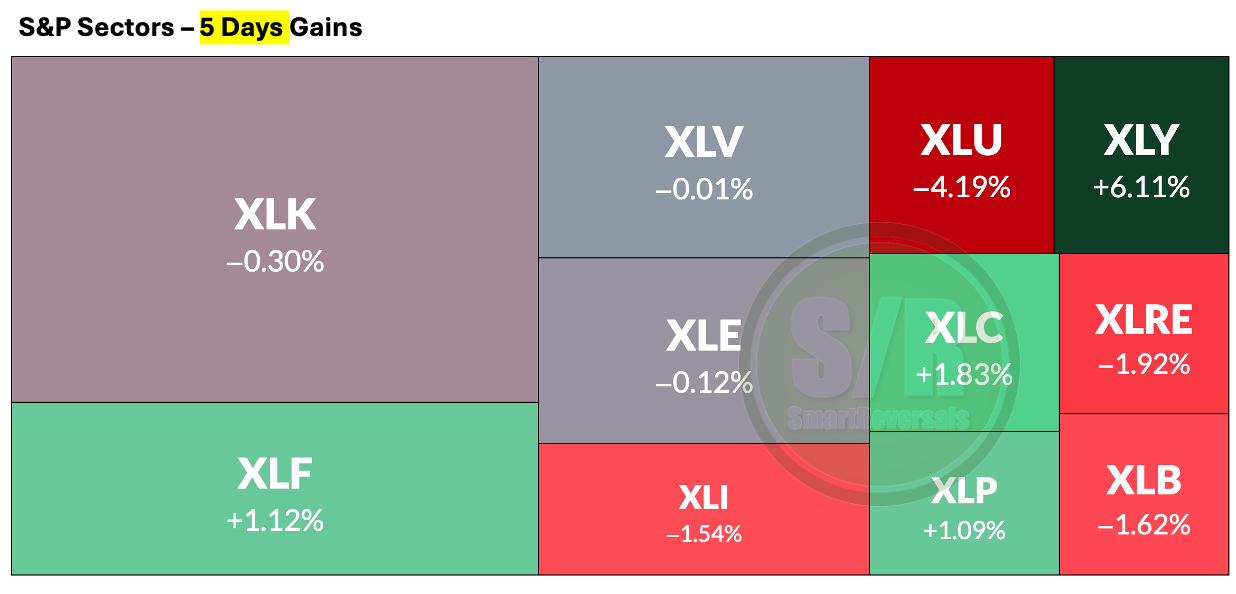
When analyzing sector performance during the week, only Consumer Discretionary closed with bullish conviction, driven by AMZN's rally while TSLA closed flat attempting to find a bottom. Financials, Communications, and Staples gained over 1% each, while all other sectors declined. Technology continued printing internal divergences; despite the rallies in MSFT and the rebound in semiconductors, the group ultimately closed flat.
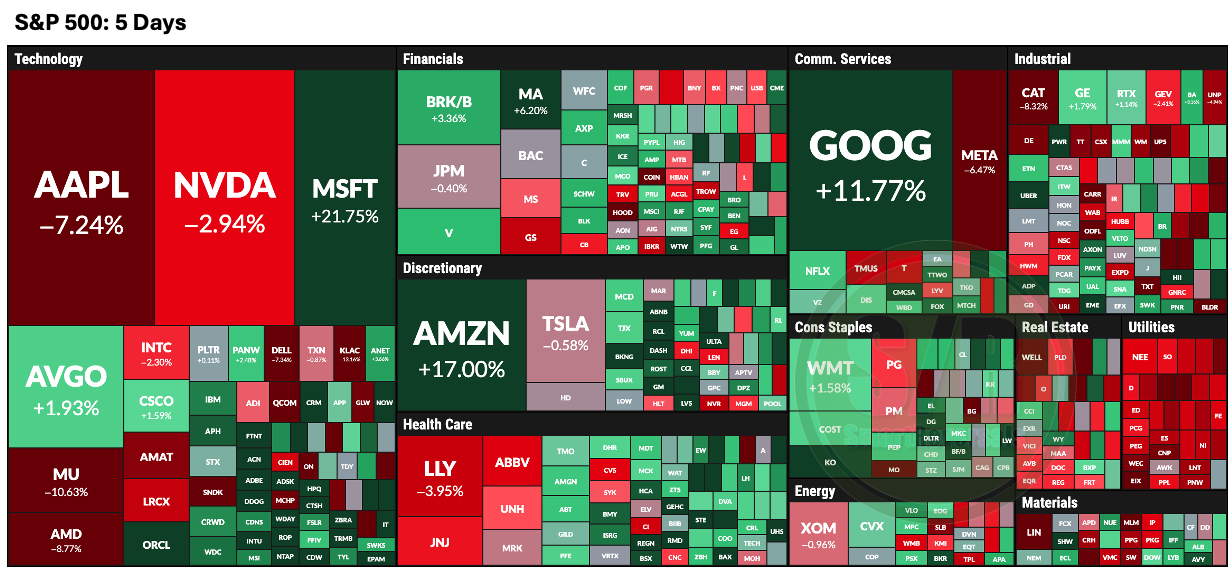
How does it happen? The gains in names like AVGO were offset by losses in NVDA, while net weekly declines in MU, AMD, AMAT, INTC, and of course, AAPL, offset the rally in MSFT. That divergence continues to demand attention for the coming week. For that reason, the daily levels for MU, AMD, AMAT, SNDK, NVDA, AVGO, and SMH will be tracked in my daily notes, along with PLTR and SPCX (SpaceX not yet in the SPX, but large enough to move the market).
When analyzing the chart for the SPX, these are the conditions and levels that must hold in order to recover bullish momentum, see the comparison with previous declines and corrections: